Magnetic particle inspection is often carried out to help determine an item’s fitness for use or conformity. This quick and relatively easy to apply technique is widely used in all industry sectors including aerospace, automotive, petrochemical, structural steel,and power generation to inspect a variety of products and equipment such as engine, suspension and braking system components, castings, forgings and weldments.
The method can detect surface or near-surface flaws such as cracks, laps, seams and inclusions in ferromagnetic materials such as iron and steel. One of the main advantages of magnetic particle inspection is that it can give an immediate indication of defects and discontinuities.
Our techniques for magnetic particle inspection include:
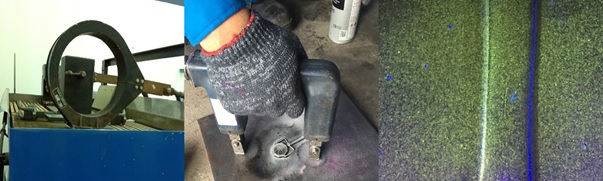
Applicable standard:
 Công ty Cổ phần AITECH
THE RELIABILITY OF NON-DESTRUCTIVE TESTING
TRỤ SỞ CHÍNH: 119/27 Bùi Quang Là, Phường An Hội Tây, Tp. Hồ Chí Minh.
CHI NHÁNH: Số 23, Đường 27, Khu đô thị Vạn Phúc, Phường Hiệp Bình, Tp. Hồ Chí Minh.
Số điện thoại: (+84)98 139 8185 - 090 886 4479
Email:maianhtai@ndt.com.vn