Loading...
Loading...

THỐNG KÊ TRUY CẬP

  • : 0
  • : 0

API 510 (PRESSURE VESSEL INSPECTOR) TRAINING

Chi phí:

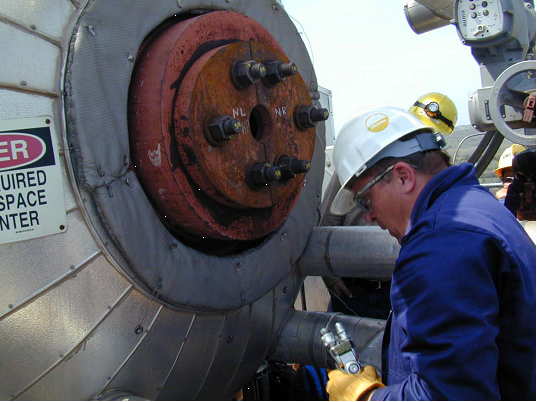
pressure-vessel-manway-door-3d-scan-inspection - 3D Scanning Services in USA from Arrival 3D, Inc.

Picture 1: Pressure vessel inspector

Advantage

This certification program benefits employers and the industry as a whole by helping to:

  • Improve management control of process unit operation, repair, and maintenance of pressure vessels
  • Reduce the potential for inspection delays
  • Provide a continued high level of safety through the use of highly specialized and experienced inspector

Training Objectives

The aim of this comprehensive preparatory course is to provide the delegates with knowledge on how to easily PASS and obtain the API 510 authorized pressure vessel inspector certification as well as:

  • Identify the various design conditions of pressure vessel components, materials, fabrication, assembly, erection, inspection, examination and testing as well as demonstrate non-destructive test methods.
  • Effectively use major codes: ASME BPVE Section V, VIII Division 1 and IX
  • Perform all basic calculations needed for the API 510 exam (e.g. minimum thickness, test pressure, MAWP, static head, MDMT, corrosion rates, remaining life, etc.)
  • Review welding procedures (WPS/PQR) and welder performance qualifications (WPQ)

Who should attend

This training course is suitable to a wide range of professionals but will greatly benefit:

  • Professionals who are interested in getting the API 510 – Authorised Pressure Vessel Inspectors Certification
  • Pressure Vessel Inspection Engineers 
  • Plant Inspectors 
  • Corrosion Engineers
  • QA/QC Inspectors
  • Asset Integrity Engineers
  • Project Engineers
  • Maintenance Engineers
  • Welding Engineers/Inspectors
  • NDT Engineers/Inspectors

No required class pre-requisites. However, if you wish to pursue the API Certification Exam, a minimal years of experience on subject matter is required depending on your educational qualifications.

Minimum Qualification Requirements for API 510 Certification

Prior to submitting an application, please use the table below to determine if you qualify to take the API 510 exam. The minimum experience required MUST be documented on your application and will be verified after your application has been submitted.

Education

Years of Experience

Experience required

BS or higher in engineering or technology

1 year

Supervision or performance of inspection activities as described in API 510

2-year Associate's degree or certificate in engineering or technology

2 năm

Design, fabrication, repair, operation, or inspection of pressure vessels, of which one year must be in supervision or performance of inspection activities as described in API 510

High school diploma or equivalent

3 years

Design, fabrication, repair, operation, or inspection of pressure vessels, of which one year must be in supervision or performance of inspection activities as described in API 510

No formal education

5 or more years

Design, fabrication, repair, operation, or inspection of pressure vessels, of which one year must be in supervision or performance of inspection activities as described in API 510

Codes and Standards Required 

All participants must bring the API and ASME code documents referenced in the latest API 510 Publication Effectivity Sheet :

  • API 510, Pressure Vessel Inspection Code: Maintenance Inspection, Rating, Repair, and Alteration, 10th Edition, May 2014 with Addendum 1, May 2017 and Addendum 2, March 2018.
  • API Recommended Practice 571, Damage Mechanisms Affecting Fixed Equipment in the Refining Industry, 3rd edition, March 2020

ATTENTION: Only the following sections / mechanisms from RP 571 are included on the exam:

Section 2 Terms and Definitions
Par. 3.3 Amine Stress Corrosion Cracking
3.8 Atmospheric Corrosion
3.11 Brittle Fracture
3.14 Caustic Corrosion
3.15 Caustic Stress Corrosion Cracking
3.17 Chloride Stress Corrosion Cracking
3.20 Cooling Water Corrosion
3.22 Corrosion Under Insulation (CUI)
3.27 Erosion/Erosion-Corrosion
3.36 High-temperature Hydrogen Attack
3.37 Hydrochloric Acid Corrosion
3.43 Mechanical Fatigue (including Vibration-induced Fatigue)
3.58 Sour Water Corrosion (Acidic)
3.61 Sulfidation
3.67 Wet H2S Damage (Blistering/HIC/SOHIC/SCC)

  • API Recommended Practice 572, Inspection of Pressure Vessels, 4th Edition, December 2016.
  • API Recommended Practice 576, Inspection of Pressure-Relieving Devices, 4th Edition, April 2017.
  • API Recommended Practice 577, Welding Inspection and Metallurgy, 2nd Edition, December 2013.
  • API Recommended Practice 578, Guidelines for a Material Verification Program (MVP) for New and Existing Assets, 3rd edition, February 2018
  • American Society of Mechanical Engineers (ASME), Boiler and Pressure Vessel Code, 2019 Edition

i. Section V, Nondestructive Examination, Articles 1, 2, 6, 7 and 23 (Section SE-797 only)

ii. Section VIII, Rules for Construction of Pressure Vessels, Division 1; Introduction (U), UG, UW, UCS, Appendices 1-4, 6, 8 and 12

iii. Section IX, Qualification Standard for Welding, Brazing and Fusion Procedures; Welders; Brazers; and Welding, Brazing and Fusing Operators, (Welding only)

Daily Agenda

Day 1

API 510 (Pressure Vessel Inspection Code)

  • Scope, organization and definitions based on the code
  • Inspection, examination and pressure testing practices
  • Determination of inspection interval / frequency and extent of inspection
  • Corrosion rate and remaining life calculations
  • MAWP determination
  • Fitness for service evaluations
  • Reporting and records
  • Repairs and alterations
  • Rerating

API RP 572 (Inspection of Pressure Vessels)

  • Types of pressure vessels
  • Reasons for inspection
  • Inspection planning
  • Inspection methods and limitations
  • Recording and reporting

Day 2

API RP 577 (Welding Inspection and Metallurgy)
Definitions
Welding inspection, processes, procedure, materials
Welder qualifications
Non-destructive examination
Metallurgy
Refinery and Petrochemical Plant Welding Issues

ASME BPVC Section IX (Welding and Brazing Qualifications)

  • Review of a WPS and PQR
  • Determine if WPS and PQR are in compliance with ASME Sec. IX
  • Essential and Nonessential Variables
  • Determine that the number and type of mechanical tests are correct tests
  • Determine whether the results are acceptable

Day 3

ASME BPVC Section VIII Division 1 (Rules for Construction of Pressure Vessels)

  • Scope and organization of the code
  • Design minimum requirements and definitions
     
  • Compensation of pressure due to static head
  • Required thickness of shell and heads due to internal pressure
  • Determination of joint efficiencies
  • Required thickness of shell due to external pressure
  • Nozzle reinforcements and its limits
  • Permissible out-of-roundness
  • Impact testing requirements and exemptions
  • Heat treatment requirements
  • Welding requirements
  • Pressure test requirements
  • Non-destructive testing requirements
  • Marking and reports

Day 4

ASME Boiler and Pressure Vessel Code Section V (Nondestructive Evaluation)
Article 1, general requirements
Article 2, radiographic examination
Article 6, liquid penetrant examination
Article 7, magnetic particle examination (yoke and prod techniques only)
Article 23, Section SE – 797
Marking and record keeping

API RP 576 (Inspection of Pressure – Relieving Devices)
•    Scope, terms and definitions
•    Types of pressure-relieving devices
•    Causes of improper performance
•    Inspection and testing
•    Records and reports

Day 5

API RP 571 (Damage Mechanisms in the Refining Industry)

  • Brittle Fracture
  • Erosion.Erosion Corrosion
  • Mechanical Fatigue
  • Atmospheric Corrosion
  • Corrosion Under Insulation (CUI)
  • Cooling water corrosion
  • Caustic corrosion
  • Sulfidation
  • Chloride Stress Corrosion Cracking (CISCC)
  • Hydrochloric acid (HCL) corrosion
  • Sour water corrosion (acidic)
  • Amine stress corrosion cracking
  • Wet H2S Damage (Blistering/HIC/SOHIC/SCC)
  • High Temperature Hydrogen Attack (HTTA)

Final

API 510 Full Mock-up Test, OPEN and CLOSED BOOK 

dịch vụ LIÊN QUAN

PROFESSIONAL MAGNETIC FIELD MEASUREMENT SERVICE – IATA & ICAO COMPLIANT

AITECH cung cấp dịch vụ đo từ trường theo IATA DGR & ICAO TI. Đo tại chỗ, cấp chứng thư quốc tế, hỗ trợ 24/7, đảm bảo hàng hóa được hãng bay chấp nhận.

Tank Inspection Services According to API 653 Standard – AITECH

AITECH provides comprehensive tank inspection services in compliance with API 653, covering visual inspection, ultrasonic thickness measurement (UTM), non-destructive testing (NDT), dimensional survey, and acoustic emission (AE). Our inspection programs are designed to ensure structural integrity, operational safety, and regulatory compliance for oil, chemical, and industrial storage tanks.

Construction & Pre-Commissioning NDT Inspection | AITECH

AITECH delivers NDT and technical inspection services for construction and pre-commissioning phases, ensuring safety, quality, and international compliance.

AITECH Infrared Thermography - Predictive Maintenance Solution to Detect Hotspots & Prevent Failures

AITECH provides professional infrared thermography inspections with ISO/ASNT certified experts. Detect hidden hotspots, prevent fire hazards, minimize downtime, and ensure equipment reliability.
NONDESTRUCTIVE TESTING