AITECH cung cấp dịch vụ kiểm tra không phá hủy (NDT) chuyên biệt cho lĩnh vực đường sắt và metro đô thị, đảm bảo đánh giá chính xác tình trạng kỹ thuật, phát hiện sớm khuyết tật và duy trì an toàn vận hành cho hệ thống hạ tầng giao thông đường sắt.
Các dịch vụ bao gồm:
1. Kiểm tra siêu âm mối hàn nhiệt nhôm theo tiêu chuẩn BS EN 14730-1
Áp dụng siêu âm chuyên dụng để kiểm tra mối hàn nhiệt nhôm (aluminothermic welds), thường sử dụng để nối ray trong thi công và sửa chữa.
Tuân thủ nghiêm ngặt tiêu chuẩn BS EN 14730-1, quy định yêu cầu kỹ thuật và phương pháp kiểm tra mối hàn trên ray thép dùng cho tàu hỏa và tàu điện.
Phát hiện các khuyết tật như nứt dọc, nứt ngang, thiếu ngấu, bọt khí… ảnh hưởng đến tính toàn vẹn của đường ray.
2. Kiểm tra từ tính (MT) phát hiện vết nứt bề mặt
Áp dụng trong kiểm tra bề mặt các mối hàn và khu vực chịu ứng suất cao trên hệ thống ray, trục bánh xe, bộ phận kết cấu thép.
Phát hiện hiệu quả các vết nứt mảnh, nứt do mỏi và khuyết tật hở bề mặt.
3. Kiểm tra thẩm thấu chất lỏng (PT)
Phù hợp cho các bề mặt phi từ tính như hợp kim nhôm, thép không gỉ.
Phát hiện các khuyết tật rất nhỏ như vết nứt, rỗ, lỗ kim... trên bề mặt mối hàn, bản ray hoặc bộ phận chuyển hướng.
4. Kiểm tra siêu âm mảng pha (PAUT) cho trục tàu điện
Áp dụng kỹ thuật Phased Array Ultrasonic Testing (PAUT) để kiểm tra trục bánh xe, trục truyền động của toa tàu.
Cung cấp hình ảnh siêu âm đa chiều, đánh giá chiều sâu và hình dạng khuyết tật một cách chính xác.
Giúp phát hiện sớm nứt mỏi, khuyết tật ăn mòn hoặc sai lệch cấu trúc bên trong trục.
5. Kiểm tra dòng điện xoáy (ECT) cho ray và thiết bị phụ trợ
Sử dụng Eddy Current Testing để phát hiện khuyết tật trên bề mặt và gần bề mặt của thanh ray, bu lông neo ray, bộ phận kết cấu nhỏ.
Phù hợp với vật liệu dẫn điện và kiểm tra nhanh chóng tại hiện trường mà không cần loại bỏ lớp sơn hoặc phủ bảo vệ.
Phương pháp kiểm tra dòng điện xoáy (ECT) là một kỹ thuật kiểm tra không phá hủy (NDT) sử dụng cảm ứng điện từ để phát hiện các khuyết tật bề mặt và cận bề mặt trên các vật liệu dẫn điện. Tại AITECH, chúng tôi ứng dụng công nghệ ECT tiên tiến trên máy AVIKO 4080 G2 để kiểm tra 100% bi thép dùng trong vòng bi năng lượng gió, công nghiệp chính xác và ngành ô tô.

Một đầu dò ECT phát ra dòng điện xoay chiều tạo ra từ trường biến thiên. Khi đầu dò tiếp cận bề mặt kim loại, dòng điện xoáy được sinh ra trong vật liệu. Nếu có khuyết tật như rạn nứt, rỗ, hay ăn mòn, dòng điện này sẽ bị thay đổi và tạo ra tín hiệu bất thường, được ghi nhận và phân tích để xác định tình trạng vật liệu.
Bi thép được khử từ đến mức <1 Gauss
Môi trường kiểm tra ổn định từ 18°C đến 28°C, không có ánh nắng trực tiếp
Bề mặt bi phải sạch, không có dầu mỡ hoặc bụi bẩn
Sử dụng bi mẫu có khuyết tật tiêu chuẩn (Master Ball) với chứng nhận từ nhà sản xuất
Thiết lập độ nhạy, dải tần số, góc pha và tín hiệu nền trên từng kênh ECT
Kiểm tra độ nhạy mỗi 4 giờ hoặc mỗi lô sản xuất mới
Bi chạy qua hệ thống cảm biến ECT tốc độ cao
Máy AVIKO tự động phát hiện và phân loại bi thành:
Bi đạt (OK)
Bi cần làm sạch và kiểm tra lại (Repairable)
Bi không đạt (NG)
Bi NG được kiểm tra thêm bằng phương pháp Macro Test (dùng axit HCl)
Nếu phát hiện lỗi vật liệu hoặc nứt gãy do công nghệ, sẽ loại bỏ theo quy định
Máy AVIKO 4080 G2 – tiêu chuẩn Châu Âu EN 15548-1
Cảm biến ECT đa tần số 150 kHz – 3600 kHz (chuẩn 400 kHz)
Đầu dò dạng 2 lõi ferrite (ECT) hoặc 4 lõi (X ECT) tùy yêu cầu độ nhạy
Phần mềm EMT tinh chỉnh pha góc và độ lợi (Gain) tùy theo loại khuyết tật
SNT-TC-1A (2024) – Chứng nhận và đào tạo nhân sự ECT
EN 15549, EN 15548-1/2/3 – Thiết bị và hiệu suất kiểm tra ECT
P3C-WE-0014 – Yêu cầu xử lý vòng bi
AITECH-NDT-WP-001 – Quy trình chứng nhận nội bộ AITECH
Bi thép cho vòng bi turbine gió
Bi cho các cụm chi tiết cơ khí chính xác
Kiểm tra phôi tròn hoặc chi tiết nhỏ có hình cầu
Các ứng dụng trong ngành ô tô, hàng không, robot, thiết bị y tế
Tất cả kỹ thuật viên được chứng nhận Level II theo SNT-TC-1A
Quy trình kiểm tra được thiết lập và giám sát bởi chuyên gia Level III
Máy móc định kỳ hiệu chuẩn, kiểm tra độ nhạy và chứng nhận chất lượng
Báo cáo kết quả kiểm tra chi tiết, kèm ảnh tín hiệu và biện pháp xử lý NG
Địa chỉ: 119/27 Bùi Quang Là, Phường An Hội Tây, TP.HCM
Chi nhánh: 23 Đường 27, KĐT Vạn Phúc, Phường Hiệp Bình, Tp Hồ Chí Minh
Hotline: 098 139 8185 – 090 886 4479
Email:aitech@ndt.com.vn
Website: https://ndt.com.vn
Tổng Quan
Tiêu chuẩn API 579-1/ASME FFS-1 là tài liệu kỹ thuật quốc tế được phát triển bởi Viện Dầu khí Hoa Kỳ (API) và Hiệp hội Cơ khí Hoa Kỳ (ASME). Tiêu chuẩn này đưa ra các phương pháp đánh giá khả năng làm việc (Fitness-For-Service – FFS) nhằm xác định xem thiết bị áp lực như bình chịu áp, đường ống, bồn chứa... có còn đủ điều kiện vận hành an toàn không.
.jpg)
API 579-1/ASME FFS-1 bao gồm quy trình đánh giá nhiều cơ chế hư hỏng phổ biến, như:
General and local metal loss
Pitting corrosion
Brittle fracture
Crack-like flaws
Creep damage
Blisters and laminations
Weld misalignment and distortion
Fire and thermal damage
Các thiết bị được thiết kế theo các tiêu chuẩn như ASME BPVC, ASME B31.3, API 650, API 620 đều có thể được đánh giá theo API 579.
Tiêu chuẩn cung cấp 3 cấp độ đánh giá, phù hợp với từng tình huống cụ thể:
Cấp độ 1 (Level 1): Sàng lọc đơn giản
Cấp độ 2 (Level 2): Tính toán kỹ thuật trung bình
Cấp độ 3 (Level 3): Phân tích chuyên sâu bằng FEM và cơ học phá hủy
Đánh giá FFS giúp:
Xác định độ bền hiện tại của thiết bị
Dự báo tuổi thọ còn lại
Tái đánh giá áp suất thiết kế (rerating)
Lập kế hoạch kiểm tra dựa trên rủi ro (RBI)
Đây là giải pháp thiết yếu trong quản lý độ tin cậy và toàn vẹn thiết bị (Asset Integrity Management), giúp doanh nghiệp tiết kiệm chi phí và tránh ngừng máy không cần thiết.
AITECH cung cấp dịch vụ đánh giá FFS và tái đánh giá áp suất thiết bị theo tiêu chuẩn API 579-1/ASME FFS-1 với đội ngũ chuyên gia giàu kinh nghiệm, thiết bị hiện đại và quy trình chuẩn hóa.
Hệ thống kiểm tra xoay bên trong (IRIS - Internal Rotary Inspection System) là một kỹ thuật kiểm tra siêu âm tiên tiến, chuyên dùng để đo độ dày thành ống và phát hiện các khuyết tật bên trong và bên ngoài. IRIS hoạt động dựa trên nguyên tắc phản xạ siêu âm, với sự hỗ trợ của môi trường ghép nối là nước để truyền sóng siêu âm hiệu quả.
Cấu tạo và nguyên lý vận hành của IRIS:
IRIS sử dụng một đầu dò siêu âm được lắp đặt bên trong ống cần kiểm tra, được bao quanh bởi nước để tạo môi trường ghép nối.
Đầu dò phát ra xung siêu âm dọc theo trục của ống. Sóng siêu âm này sau đó được phản xạ 90° thông qua một gương quay, hướng vào thành ống.
Gương phản xạ này được kết nối với một rotor, quay liên tục với tốc độ khoảng 50 vòng/giây, cho phép quét toàn bộ bề mặt bên trong của ống theo chu vi.
Khi sóng siêu âm chạm vào thành bên trong (ID - Internal Diameter) và thành bên ngoài (OD - Outer Diameter) của ống, một phần năng lượng sẽ bị phản xạ lại.
Thời gian di chuyển của sóng siêu âm từ ID đến OD được đo lường. Dựa vào vận tốc sóng siêu âm trong vật liệu đã biết, hệ thống tính toán độ dày của thành ống với độ chính xác cao.
Quy trình kiểm tra của IRIS bao gồm các bước sau:
Chuẩn bị thiết bị và ống kiểm tra:
Vệ sinh bên trong ống để loại bỏ cặn bẩn và các lớp ăn mòn bám trên bề mặt.
Lắp đặt đầu dò siêu âm vào bên trong ống cần kiểm tra.
Tạo môi trường ghép nối:
Bơm nước vào bên trong ống để tạo môi trường truyền dẫn cho sóng siêu âm. Nước đóng vai trò là chất trung gian giúp sóng siêu âm truyền tốt hơn giữa đầu dò và thành ống.
Khởi động gương quay:
Đầu dò phát xung siêu âm dọc theo trục ống.
Sóng siêu âm được phản xạ 450° nhờ gương quay, sau đó hướng vào thành ống.
Gương quay với tốc độ cao, quét toàn bộ bề mặt thành ống.
Thu thập dữ liệu phản xạ:
Sóng siêu âm phản xạ lại khi chạm vào thành bên trong (ID) và thành bên ngoài (OD) của ống.
Hệ thống đo khoảng thời gian phản xạ giữa hai bề mặt này để tính toán độ dày của thành ống.
Đồng bộ hóa tín hiệu:
Một chốt nhỏ gắn trên rotor của tuabin tạo ra tín hiệu phản xạ siêu âm mỗi khi gương đi qua, giúp đồng bộ hóa hình ảnh hiển thị trên màn hình.
Phân tích dữ liệu và báo cáo kết quả:
Dữ liệu thu thập được xử lý và phân tích để xác định các điểm ăn mòn, rỗ và giảm chiều dày của thành ống.
Báo cáo chi tiết về độ dày thành ống và vị trí của các khuyết tật được xuất ra để khách hàng tham khảo.
| Ưu điểm | Nhược điểm |
|---|---|
| Phù hợp với các vật liệu kim loại và hợp kim màu. | Cần nhiều thời gian để thiết lập và hiệu chuẩn thiết bị. |
| Phát hiện chính xác ăn mòn, rỗ và suy giảm bề dày thành ống. | Không phát hiện được vết nứt mịn hoặc nhỏ. |
| Độ chính xác cao trong phép đo độ dày. | Cần phải làm sạch bên trong ống trước khi kiểm tra để đảm bảo kết quả chính xác. |
| Phát hiện được khuyết tật cả bên trong và bên ngoài của thành ống. | Tốc độ quét chậm hơn so với phương pháp dòng điện xoáy (ECT). |
| Quét 100% bề mặt ống, không bỏ sót vùng kiểm tra. | Tốc độ kéo thấp, khoảng 2 inch/giây, làm chậm quá trình kiểm tra. |
| Dữ liệu kiểm tra được lưu trữ để phân tích sau này. | Không phù hợp với ống có lớp cặn dày hoặc bụi bẩn bám kín. |
Kiểm tra độ dày và phát hiện ăn mòn của các ống trao đổi nhiệt, nồi hơi, bộ phận gia nhiệt.
Đánh giá tình trạng ăn mòn bên trong các hệ thống đường ống dẫn dầu khí, hóa chất.
Phát hiện các vùng bị rỗ hoặc suy giảm bề dày do quá trình ăn mòn hoặc lão hóa.

Độ chính xác cao: Thiết bị IRIS hiện đại cho phép đo chính xác từng milimet độ dày thành ống.
Báo cáo chi tiết: Cung cấp bản phân tích kỹ thuật đầy đủ về độ dày và tình trạng ăn mòn của ống.
Tiết kiệm chi phí bảo trì: Phát hiện sớm các khuyết tật, giúp khách hàng chủ động bảo trì trước khi xảy ra sự cố.
Đội ngũ chuyên nghiệp: Kỹ thuật viên của AITECH được đào tạo chuyên sâu theo tiêu chuẩn quốc tế.
Để được tư vấn chi tiết về kiểm tra IRIS cho thiết bị công nghiệp, hãy liên hệ với AITECH. Chúng tôi cam kết cung cấp dịch vụ kiểm tra chính xác, an toàn và chuyên nghiệp nhất.
AITECH cung cấp dịch vụ kiểm tra sàn trực thăng (Helideck) theo tiêu chuẩn quốc tế CAP 437 do Cục Hàng không Anh (UK CAA) ban hành. Dịch vụ này nhằm đảm bảo sàn đáp trực thăng trên các giàn khoan, tàu FPSO và công trình ngoài khơi đáp ứng các tiêu chuẩn an toàn hàng không nghiêm ngặt nhất, tạo điều kiện cho máy bay trực thăng cất/hạ cánh an toàn trong mọi điều kiện thời tiết.
.JPG)
Bề mặt sàn đáp và độ ma sát: Đánh giá độ phẳng, tính chống trượt và hệ số ma sát của bề mặt helideck.
Hệ thống chiếu sáng: Kiểm tra đèn viền, đèn chỉ dẫn phương hướng, và hệ thống chiếu sáng chữ H theo tiêu chuẩn.
Vạch sơn và tín hiệu đánh dấu: Rà soát các vạch sơn, ký hiệu chữ H, vòng tròn trung tâm và thông số tải trọng tối đa của sàn.
Khả năng chịu tải và kết cấu sàn: Đánh giá tính toàn vẹn kết cấu của helideck và khả năng chịu tải trọng.
Hệ thống tiếp địa chống tĩnh điện: Kiểm tra hệ thống nối đất, đảm bảo tiêu tán điện tích tĩnh an toàn.
Khả năng thoát nước bề mặt: Đảm bảo nước mưa hoặc nhiên liệu tràn không ứ đọng trên sàn.
Lưới an toàn và thiết bị cứu hỏa: Đánh giá lưới an toàn, bình chữa cháy, hệ thống phun bọt và thiết bị cứu hỏa.
Thiết bị đo ma sát bề mặt Helideck Micro GripTester
Dụng cụ đo độ phẳng và độ dốc
Thiết bị kiểm tra hệ thống đèn chiếu sáng
Dụng cụ đo điện trở nối đất
Thiết bị đo kích thước và khoảng cách
Đảm bảo an toàn bay tối đa cho phi hành đoàn và nhân sự trên giàn khoan
Tuân thủ đầy đủ tiêu chuẩn quốc tế CAP 437
Nâng cao uy tín và niềm tin của đối tác, khách hàng
Cải thiện hiệu quả vận hành và giảm thiểu gián đoạn
Được tư vấn chuyên môn bởi đội ngũ kỹ sư giàu kinh nghiệm
Giảm chi phí bảo hiểm nhờ chứng nhận an toàn đạt chuẩn
Kiểm tra định kỳ: 6-12 tháng/lần
Kiểm tra trước vận hành: Sau khi lắp đặt hoặc nâng cấp
Kiểm tra sau sự cố hoặc sửa chữa lớn
Kiểm tra sau thời tiết cực đoan
Công ty AITECH
Địa chỉ: 119/27 Bùi Quang Là, Phường 12, Quận Gò Vấp, TP. Hồ Chí Minh
Hotline: (+84) 98 139 8185 / 090 886 4479
Email: maianhtai@ndt.com.vn
Website: https://ndt.com.vn
AITECH cung cấp dịch vụ kiểm tra phát xạ âm (Acoustic Emission - AE) cho bồn chứa xăng dầu. Đây là phương pháp kiểm tra không phá hủy hiện đại, cho phép phát hiện sớm các hư hỏng tiềm ẩn như nứt, ăn mòn, đáy bồn chứa mà không cần tháo dỡ hoặc ngừng hoạt động. Kiểm tra phát xạ âm giúp xác định vị trí, cường độ và xu hướng phát triển của khuyết tật, đảm bảo an toàn vận hành và kéo dài tuổi thọ thiết bị.
AITECH được phê chuẩn quốc tế ILAC-MRA ISO 17025 cho phương pháp Acoustic Emission, đảm bảo độ chính xác và độ tin cậy của kết quả kiểm tra theo tiêu chuẩn quốc tế.

Phát hiện rò rỉ và khuyết tật: Xác định chính xác vị trí các điểm rò rỉ, khuyết tật bên đáy bồn.
Đánh giá mức độ ăn mòn: Giám sát tình trạng ăn mòn bên trong bồn chứa theo thời gian, đặc biệt là các khu vực chịu áp lực lớn.
Phân tích xu hướng phát triển khuyết tật: Dự đoán khả năng lan rộng của khuyết tật dựa trên dữ liệu phân tích.
Đánh giá tổng thể tình trạng bồn chứa: Báo cáo chi tiết về tình trạng hiện tại của bồn, từ đó đưa ra giải pháp bảo trì hoặc thay thế kịp thời.
Cảm biến phát xạ âm (AE Sensors)
Bộ thu thập dữ liệu phát xạ âm (AE Data Acquisition System)
Phần mềm phân tích dữ liệu phát xạ âm chuyên dụng
Thiết bị Acoustic Vallen của Đức: Vallen AMSY-6, hệ thống giám sát phát xạ âm hiện đại, cho phép phân tích chính xác nguồn phát âm thanh bất thường trong bồn chứa, phát hiện sớm các hư hỏng như nứt, ăn mòn hoặc sự thay đổi cấu trúc.
Phát hiện sớm các hư hỏng tiềm ẩn: Giúp ngăn ngừa sự cố nghiêm trọng trước khi xảy ra.
Không cần dừng hoạt động: Giảm thiểu thời gian ngừng máy và tối ưu hóa hiệu suất vận hành.
Giảm thiểu chi phí bảo trì: Nhờ phát hiện sớm, doanh nghiệp có thể lên kế hoạch bảo trì định kỳ hiệu quả.
Đảm bảo an toàn vận hành: Tránh nguy cơ cháy nổ và hư hỏng lớn cho bồn chứa xăng dầu.
Đáp ứng các tiêu chuẩn quốc tế: Phương pháp AE đáp ứng các tiêu chuẩn ASTM, ASME và API.
Báo cáo kiểm tra chi tiết và đáng tin cậy: Cung cấp đầy đủ dữ liệu phân tích và hình ảnh minh họa.
Sử dụng thiết bị Acoustic Vallen của Đức: Hệ thống giám sát hiện đại giúp tăng cường độ chính xác và độ tin cậy của kết quả kiểm tra.
Kết hợp chuyên gia API 653 và ASNT Level 3 AE: Đánh giá toàn vẹn bồn chứa, đưa ra phân tích chi tiết và đề xuất giải pháp kỹ thuật tối ưu.
Kiểm tra định kỳ:** 1-4 năm/lần
Giám sát liên tục: Được thực hiện trong các hoạt động vận hành quan trọng.
Công ty AITECH
Địa chỉ: 119/27 Bùi Quang Là, Phường 12, Quận Gò Vấp, TP. Hồ Chí Minh
Hotline: (+84) 98 139 8185 / 090 886 4479
Email:maianhtai@ndt.com.vn
Website:https://ndt.com.vn
Kiểm tra bằng kỹ thuật Dòng điện xoáy (ECT)
Sử dụng phương pháp không tiếp xúc để kiểm tra các ống phi sắt từ. Kỹ thuật này thích hợp để phát hiện và và đánh giá kích thước các khuyết tật của kim loại như ăn mòn, corrosion, xói mòn, xước, ăn mòn pitting, vết cắt do vách ngăn, giảm chiều dày thành ống, và các vết nứt trong vật liệu phi sắt từ.
Ứng dụng cho:
.png)
Hình 1. Kỹ thuật Dòng điện xoáy (ECT)
Kiểm tra bằng kỹ thuật Dòng điện xoáy mảng pha (ECA)
Hỗ trợ thêm cho phương pháp ECT để kiểm tra các khuyết tật tại vị trí giá đỡ, có hiển thị C-Scan, hỗ trợ đa tần số.
.png)
Hình 2. Kỹ thuật Dòng điện xoáy mảng pha (ECA)
Kiểm tra bằng kỹ thuật Siêu âm đầu dò quay (IRIS)
Được sử dụng cho nhiều loại vật liệu khác nhau bao gồm các vật liệu sắt từ, phi sắt từ và phi kim loại. Sử dụng kỹ thuật này có thể phát hiện các khuyết tật như giảm chiều dày thành ống do ăn mòn, xói mòn, xước, ăn mòn pitting, nứt, và các vết cắt do vách ngăn. Kỹ thuật kiểm tra IRIS thường được sử dụng như một phương pháp đối chứng cho kỹ thuật từ trường xa, từ trường dò, và dòng điện xoáy.
Ứng dụng cho:
.png)
Hình 3. Hệ thống Siêu âm đầu dò xoáy (IRIS)
Kiểm tra bằng kỹ thuật Từ trường xa (RFT)
Được sử dụng cho các kiểm tra đường ống bằng thép có từ tính như thép Cacbon thép không gỉ. Công nghệ của Olympus cùng với đầu dò từ trường xa có độ nhạy cao khi dùng để phát hiện và đánh giá các khuyết tật có thể tích lớn được tạo ra bởi ăn mòn, xói mòn, xước, và vết cắt do vách ngăn.
Ứng dụng cho:

Hình 4. Phương pháp Từ trường xa (RFT)
Kiểm tra bằng kỹ thuật Từ trường gần (NFT)
Có tốc độ nhanh và chi phí thấp chuyên dùng để kiểm tra các ống thép Cacbon với các tấm tản nhiệt bao quanh. Kỹ thuật dựa trên đầu dò dòng xoáy kiểu driver-pickup cho tín hiệu rất dễ để giải đoán. NFT đặc biệt thích hợp cho kiểm tra các ăn mòn, xói mòn, hoặc ăn mòn pitting bên trong ống thép Cacbon. Tín hiệu của phương pháp NFT không sử dụng sự thay đổi về pha mà sử dụng hiệu ứng lift-off hay “fill factor” để giải đoán dựa trên biên độ phản hồi. Do độ đâm xuyên của dòng điện xoáy giới hạn ở gần bề mặt trong của ống nên các tấm tản nhiệt bên ngoài không ảnh hưởng đến tín hiệu.
.png)
Hình 5. Phương pháp Kiểm tra từ trường gần (NFT)
Kiểm tra bằng kỹ thuật Từ trường rò (MFL)
Là công nghệ kiểm tra nhanh, thích hợp để đo tỷ lệ suy giảm thành ống và phát hiện các khuyết tật sắc nét như ăn mòn pitting, rãnh cắt, và các nứt dọc theo chu vi ống. MFL rất hữu hiệu cho kiểm tra ống thép Cacbon với tấm tản nhiệt nhôm do từ trường không bị ảnh hưởng bởi các tấm nhôm này.
Ứng dụng cho:
.png)
Hình 6. Phương pháp Kiểm tra Từ trường rò (MFL)
AITECH cung cấp dịch vụ kiểm tra đáy bồn chứa bằng công nghệ rò rỉ từ thông - MFL (Magnetic Flux Leakage), một phương pháp kiểm tra không phá hủy (NDT) hiện đại, giúp phát hiện và bản đồ hóa các vị trí ăn mòn, mất kim loại tại đáy bồn chứa xăng dầu, hóa chất hoặc dầu thô.

Phát hiện chính xác vị trí và mức độ ăn mòn.
Tốc độ quét nhanh, phù hợp với bồn có diện tích lớn.
Dữ liệu đầu ra là bản đồ ăn mòn 2D hoặc 3D, dễ dàng đánh giá và lưu trữ.
Phù hợp với các yêu cầu kiểm tra định kỳ theo API 653.
Bồn chứa nhiên liệu, hóa chất, dầu thô đặt nổi.
Các đợt bảo trì, turnaround, hoặc khảo sát tình trạng bồn trước cải tạo.
Tiêu chuẩn áp dụng: API 653, EEMUA 159
Thiết bị MFL sử dụng: Truflux, MFE,
AITECH triển khai phương pháp kiểm tra siêu âm sóng dẫn (GWUT) bằng hệ thống thiết bị tiên tiến, cho phép đánh giá toàn diện tình trạng đường ống từ một vị trí duy nhất mà không cần tháo cách nhiệt hoặc lớp phủ bên ngoài.
Wavemaker® G4mini
Thiết bị tiêu chuẩn công nghiệp cho kiểm tra GWT, mang lại hiệu quả cao trong việc quét nhanh các đoạn ống dài với khả năng bao phủ thể tích 100% từ một vị trí đặt vòng cảm biến. Thiết kế nhỏ gọn, nhẹ và tích hợp tính năng nhận dạng cảm biến tự động giúp tối ưu thao tác tại hiện trường.

Phần mềm WavePro4™
Chạy trên nền Windows®, phần mềm hỗ trợ thu thập, phân tích và lập báo cáo kết quả kiểm tra. Tính năng nổi bật gồm:
Phân tích trực quan C-Scan với giấy phép EFC (Enhanced Focusing Capability)
Tự động hiệu chuẩn biên độ với tính năng Absolute Calibration
Giả lập phản xạ giúp phân biệt tín hiệu giả và thực

Cảm biến nhiệt độ cao EFC cho các đường kính ống: 6", 10", 12"
Vòng cảm biến đặc (solid ring) cho ống 2", 3", 4"
Mô-đun tần số chuẩn và tần số rộng (35mm)


Hệ thống Wavemaker G4 Mini sử dụng sóng siêu âm dẫn (guided waves) lan truyền dọc theo chiều dài ống để phát hiện các bất thường như:
Ăn mòn trong, ăn mòn ngoài
Giảm độ dày do mài mòn
Nứt hoặc thay đổi hình dạng tiết diện
Sóng siêu âm được phát ra bởi một vòng cảm biến bao quanh ống.
Sóng lan truyền theo hai chiều trên trục ống (axial direction) và phản xạ trở lại khi gặp sự thay đổi về tiết diện (cross-section).
Các tín hiệu phản xạ được thu lại, phân tích để xác định vị trí và mức độ bất thường.
Axial direction: Hướng dọc trục ống

Circumferential extent: Phạm vi ảnh hưởng theo chu vi ống (%)

Cross-section change: Sự thay đổi diện tích mặt cắt ngang (do ăn mòn hoặc mối hàn)

C-Scan: Hình ảnh dạng bản đồ trải phẳng ống, hiển thị vị trí và dạng bất thường

Kiểm tra ống dài, ống ngầm, ống cách nhiệt mà không cần tháo gỡ
Không phá huỷ, không ảnh hưởng đến vận hành hệ thống
Phát hiện ăn mòn nội và ngoại với độ nhạy cao
Hệ thống thiết bị đạt chuẩn quốc tế, phần mềm cập nhật liên tục
Nhân sự có chứng chỉ quốc tế, kinh nghiệm nhiều dự án dầu khí trọng điểm
Đối tượng tham gia
■ Nhân viên kỹ thuật
■ Kỹ thuật viên NDT
■ Kỹ sư
■ Kỹ sư giám sát ....
Mục tiêu khóa học
■ Hiểu rõ về nguyên lý và ứng dụng của kiểm tra siêu âm
■ Hiểu rõ về ưu nhược điểm của phương pháp và lựa chọn kỹ thuật thích hợp cho việc kiểm tra
■ Có đủ kiến thức và năng lực để thực hiện chuẩn thiết bị kiểm tra phù hợp với tiêu chuẩn yêu cầu.
■ Có khả năng giải đoán đánh giá kết quả kiểm tra theo quy phạm, tiêu chuẩn và yêu cầu kỹ thuật.
■ Có khả năng báo cáo kết quả kiểm tra theo quy trình kiểm tra phù hợp
THỰC HÀNH
Thực hành bằng thiết bị kiểm tra siêu âm hiện đại như EPOCH 650, và hệ thống mẫu khuyết tật đa dạng

Hình 1: Thiết bị sử dụng trong kiểm tra bằng sóng siêu âm (UT)
■ Chức năng các núm điều khiển máy dò khuyết tật bằng siêu âm
■ Chuẩn máy dò khuyết tật siêu âm dùng đầu dò thẳng
■ So sánh các chất tiếp âm
■ Chuẩn máy dò khuyết tật siêu âm dùng đầu dò góc
■ Đo chiều dày bằng máy dò khuyết tật siêu âm
■ Thực nghiệm quá trình chuyển đổi dạng sóng
■ Đo vận tốc sóng âm trong vật liệu bằng máy dò khuyết tật siêu âm
■ Vẽ tiết diện chùm tia siêu âm trong mặt phẳng ngang và đứng.
■ Đặt độ nhạy máy siêu âm dùng đầu dò góc bằng mẫu DAC ASME
■ Xác định chênh lệch tổn thất truyền qua và tổn thất do hấp thu giữa mẫu chuẩn và mẫu thép tấm kiểm tra.
■ Quy trình kiểm tra mối hàn đối đầu V đơn trên thép tấm theo ASME V
■ Quy trình kiểm tra mối hàn đối đầu V đôi trên thép tấm theo ASME V và AWS D1.1
■ Kiểm tra mối hàn chữ T thấu hoàn toàn trên thép tấm theo AWS D1.1
PAUT là phương pháp kiểm tra siêu âm tiên tiến hơn UT, đầu dò PAUT bao gồm rất nhiều biến tử nhỏ, có thể được kích hoạt độc lập (đa biến tử). Bằng cách thay đổi thời gian kích thích từng biến tử riêng biệt theo một quy luật xác định, một bề mặt sóng được phát ra theo một hướng xác định (do giao thoa sóng âm).
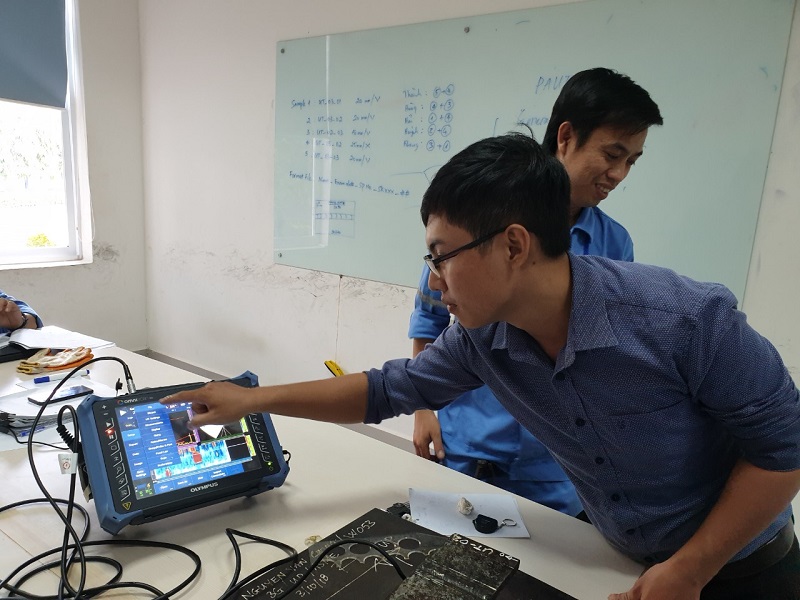
Nói một cách khác, hướng của sóng âm có thể được điều khiển sử dụng hoàn toàn các tín hiệu điện (thay đổi góc phát). Dữ liệu từ nhiều chùm sóng âm với các góc khác nhau được tổng hợp lại, tạo thành hình ảnh lát cắt trong vật thể (A-Scan, S-Scan, B-scan, C-Scan)
Các ứng dụng PAUT trong kiểm tra đánh giá:
- Kiểm tra mối hàn
- Kiểm tra vật liệu cơ bản, đúc, rèn,..
- Vẽ biểu đồ vật liệu bị ăn mòn
- Scan các chi tiết có cấu tạo phức tạp.
ĐỐI TƯỢNG THAM GIA
MỤC TIÊU KHÓA HỌC
Tổng quan
Visual Testing là sự quan sát vật kiểm tra trực tiếp bằng mắt thường hoặc gián tiếp qua các dụng cụ quang học để đánh gái các bất thường trên bề mặt cũng như đánh giá tính phù hợp của vật kiểm tra đối với một tiêu chuẩn nào đó.
Visual Testing giúp xem xét và từ đó phát hiện ra nhiều loại bất liên tục trên bề mặt. Nó còn là phương pháp được sử dụng rộng rãi nhất để xem xét và phát hiện các bất liên tục trên bề mặt kèm theo nhiều cơ chế hư hỏng khắc nhau về mặt cấu trúc. Phương pháp Visual Testing vẫn cung cấp một sự hỗ trợ rất hữu ích thậm chí ngay khi các phương pháp NDT khác đã được sử dụng. Ví dụ như khi phương pháp Eddy Current trên ống được sử dụng, phương pháp Visual Testing thường được thực hiện nhằm xác thực thêm kết quả và giúp xem xét điều kiện bề mặt. Quá trình xác thực này có thể đóng góp một tác dụng rất đáng kể tới việc đánh giá kết quả ở các phương pháp NDT khác.
Các bất liên tục sau đây có thể đơn giản được phát hiện bằng Visual Testing: các bất liên tục bề mặt, vết nứt, lệch mép, cong vênh, ăn mòn, mài mòn và các hư hỏng về mặt vật lý.

Tiêu chuẩn áp dụng
ĐỐI TƯỢNG THAM GIA
■ Nhân viên kỹ thuật
■ Kỹ thuật viên NDT
■ Kỹ sư
■ Kỹ sư giám sát ....
MỤC TIÊU KHÓA HỌC
■ Hiểu rõ về nguyên lý và ứng dụng của kiểm tra từ trường rò.
■ Hiểu rõ về ưu nhược điểm của phương pháp và lựa chọn kỹ thuật thích hợp cho việc kiểm tra.
■ Có đủ kiến thức và năng lực để thực hiện chuẩn thiết bị kiểm tra phù hợp với tiêu chuẩn yêu cầu.
■ Có khả năng giải đoán đánh giá kết quả kiểm tra theo quy phạm, tiêu chuẩn và yêu cầu kỹ thuật.
■ Có khả năng báo cáo kết quả kiểm tra theo quy trình kiểm tra phù hợp
.png)
ĐỐI TƯỢNG THAM GIa
■ Nhân viên kỹ thuật
■ Kỹ thuật viên NDT
■ Kỹ sư
■ Kỹ sư giám sát ....
MỤC TIÊU KHÓA HỌC
■ Hiểu rõ về nguyên lý và ứng dụng của kiểm tra từ tính
■ Hiêu rõ về ưu nhược điểm của phương pháp và lựa chọn kỹ thuật thích hợp cho việc kiểm ta
■ Có đủ kiến thức và năng lực để thực hiện chuẩn thiết bị kiểm tra phù hợp với tiêu chuẩn yêu cầu.
■ Có khả năng giải đoán đánh giá kết quả kiểm tra theo quy phạm, tiêu chuẩn và yêu cầu kỹ thuật.
■ Có khả năng báo cáo kết quả kiểm tra theo quy trình kiểm tra phù hợp
THỰC HÀNH
Thực hành bằng thiết bị kiểm tra từ tính bằng thiết bị cầm tay Yoke, Coil và hệ thống mẫu khuyết tật đa dạng.

Kiểm tra bột từ mẫu khuyết tật chuẩn trong mối hàn và các chi tiết chịu tải trọng.
Kiểm tra bột từ mối hàn theo ASME V, VIII, B31.1 và AWS D 1.1:
Hiện tại AITECH là công ty hàng đầu có thể kiểm tra thẩm thấu bằng tất cả các kỹ thuật trên tại Việt Nam và trong khu vực. AITECH cung cấp dịch vụ kiểm tra thẩm thấu mối hàn và các chi tiết thiết bị bằng nhiều kỹ thuật đa dạng:
- Kiểm tra thẩm thấm màu loại bỏ chất thẩm thấu dư bằng dung môi.
- Kiểm tra thẩm thấu huỳnh quang loại bỏ chất thẩm thấu dư bằng dung môi.
- Kiểm tra thẩm thấu huỳnh quang rữa nước
- Kiểm tra thẩm thấu huỳnh quang hậu nhũ tương.

Tiêu chuẩn đánh giá áp dụng:
Có hai kỹ thuật chính trong kiểm tra trực quan bao gồm:
- Kỹ thuật kiểm tra trực tiếp
- Kỹ thuật kiểm tra nội soi.

Tiêu đánh giá tham khảo:
Structural welding: AWS D1.1
Power piping welding: ASME B31.1
Piping process welding: ASME B31.3
ISO 5817: Welding — Fusion-welded joints in steel, nickel, titanium and their alloys (beam welding excluded) —Quality levels for imperfections.
Others standard: AS, JIS, ASTM ….
 Công ty Cổ phần AITECH
THE RELIABILITY OF NON-DESTRUCTIVE TESTING
TRỤ SỞ CHÍNH: 119/27 Bùi Quang Là, Phường An Hội Tây, Tp. Hồ Chí Minh.
CHI NHÁNH: Số 23, Đường 27, Khu đô thị Vạn Phúc, Phường Hiệp Bình, Tp. Hồ Chí Minh.
Số điện thoại: (+84)98 139 8185 - 090 886 4479
Email:maianhtai@ndt.com.vn